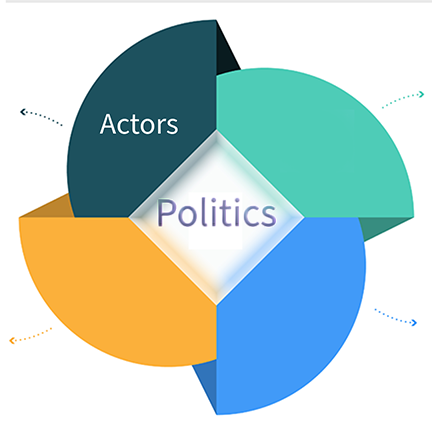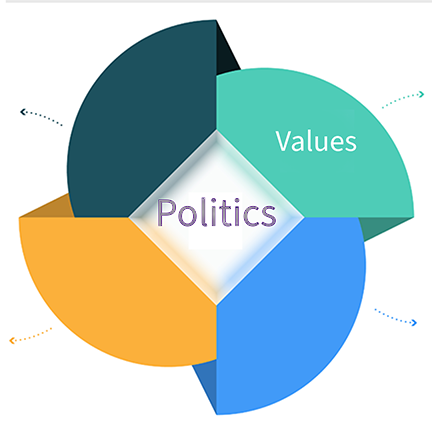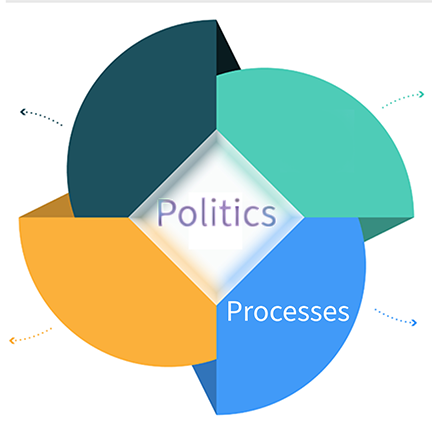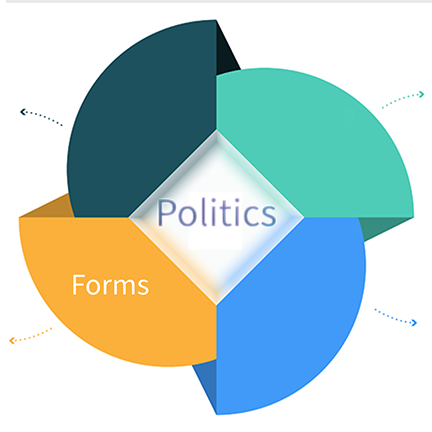
Politics can be discussed as having four parts: actors, values, forms, and processes. Though they are inseparable in reality, we need to talk about them one piece at a time to understand this reality. These parts are the anatomy of politics.
"If we could just get rid of politics" is the same as saying "If we could just get rid of people." Knowing who is acting for whom is vital to understanding politics. Both the "who" and "whom" are ultimately persons. No matter how often we talk about what a group, company, or country did, none of these structures or institutions, in reality, "acts" — only persons do.
What we see actors doing, especially what we remember and talk about, grants power to the actor. Action over time shows an actor's capability and influence. Most often when we speak of someone's "power" we are short-handing a description of ongoing relationships among a set of actors. The power we grant results from our experience, values, priorities, and culture.
Our own values and the values each actor brings to a policy setting are a mixed bag. Values combined and filtered from many actors become the source of the policy objectives. Liberal and conservative describe a group of values, but these are only gross descriptors. Values like honesty, empathy, security, and health also form the basis of policy actions.
Values allow us to measure the amount of success a policy action produces. They provide a screen through which actors filter information in decision-making. Stating and clarifying values can reduce deliberation time and facilitate consultation. Determining an actor's values is critical to understanding what choices the actor has made and will make.
Forms are the structures, organizations, institutions, and pragmatic arrangements within which politics takes place — the policy arenas wherein actors play political games. The forms both limit and allow what actions are possible within the arena. Some structures are rigidly hierarchical; some are loosely bound.
When we analyze the decisions an actor makes, we must take into account the arena within which the action takes place. Within a family or small business form, we think more about individual principles. City, state, and corporate forms use principles associated with communities. National and international politics are institutional, wherein law, authority, and citizenship are in focus. All principles matter across all forms, but our focus determines what actors, challenges, and opportunities we see.
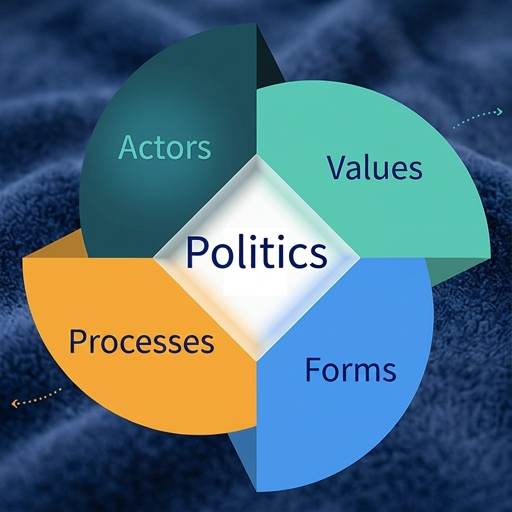
Policy — the critical guidance function in managing any group — is a product of political processes. This is true regardless of the policy content, be it financial, economic, technological, military, diplomatic, legal, or ecological. While political processes may be conceptually separable from economic, military, legal, and psychological systems, it is within these and other systems that political processes operate.
Human systems and their processes interlock — and politics is the oil (or sand) in the gears that keep them moving. Politics is how actors use processes to make and implement policy based on values shared within the structures of a society.
Positive politics may take longer — but we achieve more and have more fun doing it.